Lesson 6 of 9 in How Google and AI assistants find a business · Module 2
Crawling for AI training versus crawling for answers

Beginner4 minChecked on November 20, 2026
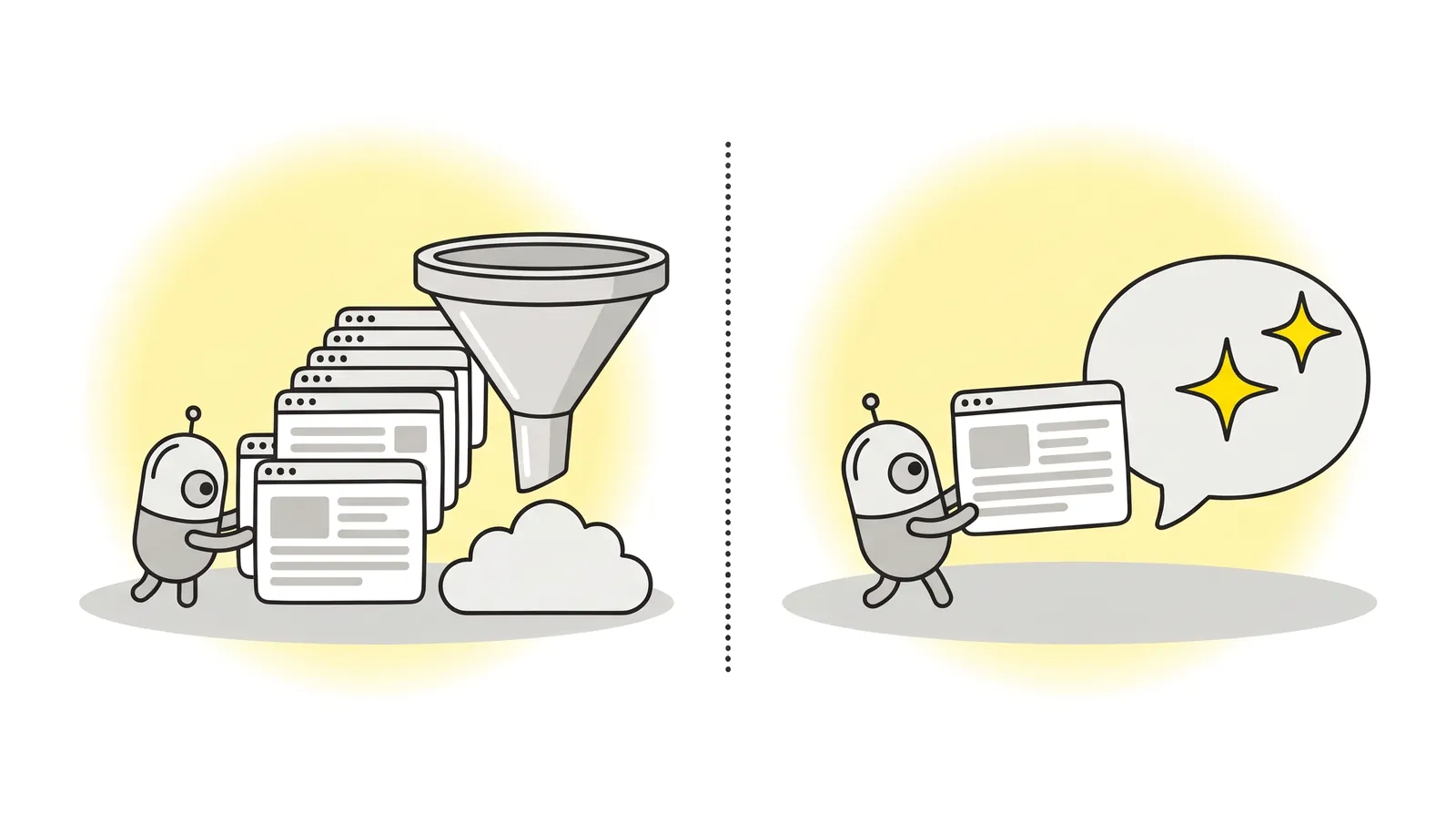
An AI company reads web pages mainly for two purposes: to collect content that may be used to train its models, and to show pages in its assistant's answers, through search crawlers that read pages automatically and fetchers that visit a page when someone asks a question. OpenAI and Anthropic give the two purposes separate names in robots.txt, so a business can accept one and refuse the other. Google draws its line elsewhere, between Google Search and its Gemini models.
Training and answering are separate jobs
GPTBot crawls content that may be used to train OpenAI's generative AI foundation models. Disallowing it indicates that a site's content should not be used in that training. ClaudeBot, which Anthropic calls its training crawler, collects web content that could contribute to training Anthropic's models. Restricting ClaudeBot signals that the site's future materials should be excluded from Anthropic's training datasets.
Answering falls to the search crawlers and fetchers described in the crawlers behind ChatGPT, Perplexity and Claude. Perplexity says PerplexityBot is not used to crawl content for AI foundation models, and that Perplexity-User is not used to collect content for training them.
Each setting stands on its own
OpenAI gives the clearest example. Each of its settings is independent of the others: a site owner can allow OAI-SearchBot to appear in search results while disallowing GPTBot to indicate that crawled content should not be used for training OpenAI's models. A site that refuses GPTBot this way does not leave ChatGPT's search answers. If a site allows both robots, OpenAI may use the results of a single crawl for both purposes, to avoid crawling it twice.
Perplexity and Anthropic keep their settings apart too. Each of Perplexity's robots.txt settings works independently, and Anthropic separates its three robots so that site owners can enable the ones they want and limit the others.
What Google-Extended covers and what it leaves alone
Publishers use Google-Extended to manage whether content Google crawls from their sites may be used for two things. One is training future generations of Gemini models. The other is grounding in Gemini Apps and on Vertex AI.
It is not a separate robot: Google crawls with its existing user agents and reads the Google-Extended name in robots.txt only as a control.
Google-Extended does not affect whether a site is included in Google Search, and Google does not use it as a ranking signal there.
Because AI is built into Search, robots.txt rules for Googlebot are the control over how a site is crawled for Search, and they cover all Google Search features. AI Overviews and AI Mode are among those features, so blocking Google-Extended does not take a site out of AI Overviews. To limit the information Search shows from a page, AI features included, Google points to four controls: nosnippet, data-nosnippet, max-snippet and noindex.
Two dated announcements about training signals
As of October 30, 2026, Anthropic has begun recognizing a machine-readable signal that lets website owners express a preference about whether their content may be used to train AI models. It is rolling the signal out across its services over time. A robots.txt rule that names ClaudeBot takes priority over that general signal.
Google says it intends to support a shared, machine-readable training preference signal called AIPREF in early 2027.
Do it on your site
- Write down two separate decisions with whoever owns your content: whether you want your pages shown in AI search answers, and whether you accept that they may be used to train AI models. Blocking Google-Extended refuses Gemini training and grounding together.
- Open your robots.txt in a browser and look for GPTBot, ClaudeBot and Google-Extended, the names tied to training and, for Google-Extended, to grounding in Gemini Apps and on Vertex AI.
- Look separately for OAI-SearchBot, PerplexityBot, Claude-SearchBot and Claude-User, the names tied to search answers, and check that their rules follow your first decision rather than your second.
- If someone proposes blocking Google-Extended to leave AI Overviews or to change your Google rankings, explain that it affects neither, and that the documented way to limit what AI Overviews show from a page is nosnippet, data-nosnippet, max-snippet or noindex.
- Ask whoever runs your website to make the changes one robot name at a time, as shown in allow or block AI crawlers with robots.txt.
Check what you learned
Three questions on this module. Nothing is saved: the answers are for you.
Sources
Every fact in this lesson comes from these pages, read on the date shown.
- Overview of OpenAI Crawlers, OpenAI, read on November 19, 2026
- Does Anthropic crawl data from the web, and how can site owners block the crawler?, Anthropic, read on November 19, 2026
- Perplexity Crawlers, Perplexity, read on November 19, 2026
- Google's common crawlers, Google, read on November 19, 2026
- AI Features and Your Website, Google Search Central, read on November 19, 2026
Zaatar does this work on your site
It finds the searches your buyers make, writes the articles, prepares the technical fixes and tracks the results. Nothing goes live without your approval.
Automate my SEO